The Shahada is the first and most important pillar of Islam. It is the declaration of faith that forms the foundation of a Muslim’s belief. Every Muslim begins their journey of faith with the Shahada, and it remains a guiding principle throughout their life.
If you are new to Islam, teaching your children, or simply want to understand the basics of the Islamic faith, this guide explains the Shahada in clear and simple language.
What Is the Shahada?
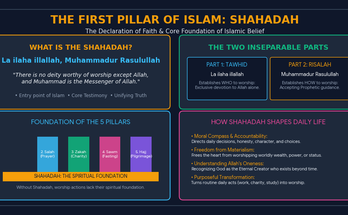
The Shahada is the Islamic declaration of faith. It states:
“Ashhadu an la ilaha illa Allah, wa ashhadu anna Muhammadan rasul Allah.”
Meaning in English:
“I bear witness that there is no god worthy of worship except Allah, and I bear witness that Muhammad is the Messenger of Allah.”
This short statement expresses the core belief of every Muslim.
Why Is the Shahada So Important?
The Shahada is called the first pillar of Islam because every other act of worship is built upon it.
When a person sincerely believes and accepts the Shahada, they acknowledge two essential truths:
- Allah alone deserves worship.
- Prophet Muhammad (ﷺ) is Allah’s final Messenger.
Without this belief, the other pillars of Islam have no foundation.
Understanding the Two Parts of the Shahada
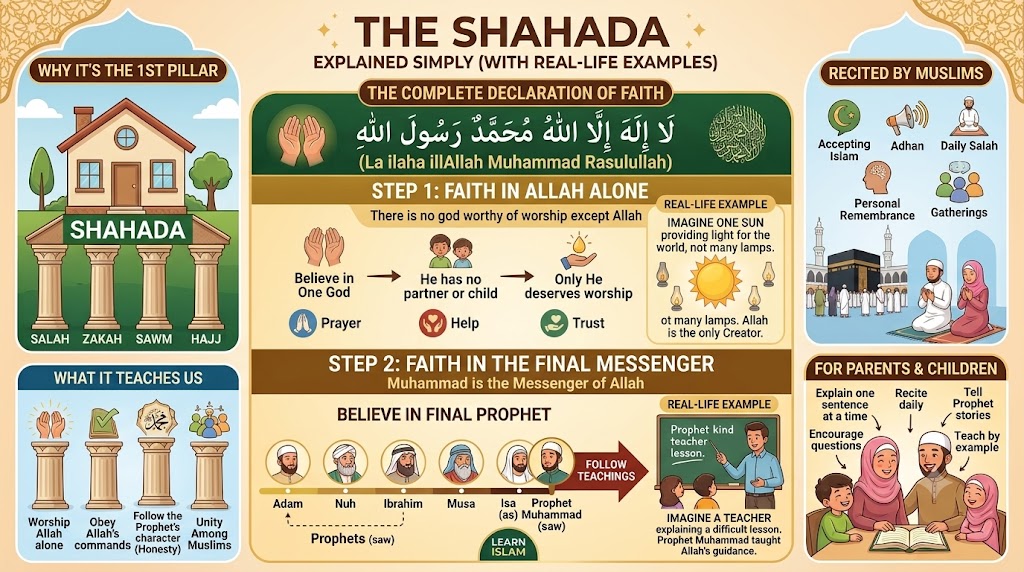
Part One: “There is no god worthy of worship except Allah”
This means Muslims believe:
- Allah is the One and Only God.
- Allah has no partner, child, or equal.
- Only Allah deserves worship.
Muslims turn to Allah in prayer, ask Him for help, and place their trust in Him alone.
Real-Life Example
Imagine the sun providing light for the whole world. While many lamps can give light inside a room, there is only one sun.
Similarly, Muslims believe there is only one true Creator and Sustainer of everything—Allah.
Part Two: “Muhammad is the Messenger of Allah”
Muslims believe that Allah sent many prophets throughout history, including:
- Adam (AS)
- Nuh (Noah) (AS)
- Ibrahim (Abraham) (AS)
- Musa (Moses) (AS)
- Isa (Jesus) (AS)
The final prophet is Muhammad (ﷺ).
Muslims follow his teachings because he delivered Allah’s message and showed people how to live according to the Quran.
Real-Life Example
Think of a teacher explaining how to solve a difficult problem. The teacher doesn’t create the lesson but helps students understand it.
Likewise, Prophet Muhammad (ﷺ) taught people how to live according to Allah’s guidance.
When Is the Shahada Recited?
Muslims recite the Shahada in many situations, including:
- When accepting Islam.
- During the daily Adhan (call to prayer).
- In daily prayers (Salah).
- During personal remembrance of Allah.
- In Islamic gatherings and reminders.
The Shahada is a constant reminder of a Muslim’s faith and purpose.
What Does the Shahada Teach Us?
The Shahada teaches many important values.
1. Belief in One God
Muslims worship only Allah and rely on Him in every part of life.
2. Obedience to Allah
Faith is not only about words. It also means trying to obey Allah’s commands and avoid what He has forbidden.
3. Following Prophet Muhammad (ﷺ)
Muslims learn from the Prophet’s character, honesty, kindness, patience, and mercy.
His life is an example of how to live according to Islamic values.
4. Unity Among Muslims
No matter where Muslims come from or what language they speak, they all share the same declaration of faith.
The Shahada unites Muslims around the world.
Why Is the Shahada the First Pillar?
The Shahada comes first because belief is the foundation of every act of worship.
Think of building a house.
Before adding walls and a roof, you first need a strong foundation.
In the same way:
- The Shahada is the foundation.
- Salah builds discipline.
- Zakah teaches generosity.
- Sawm develops patience.
- Hajj strengthens unity.
Everything begins with sincere belief in Allah.
How Parents Can Teach the Shahada to Children
Children learn best through simple explanations and daily practice.
Parents can:
- Explain the meaning one sentence at a time.
- Recite it together every day.
- Tell stories about the Prophets.
- Encourage children to ask questions.
- Teach by setting a good example.
Children remember lessons more easily when they hear them regularly and understand their meaning.
Common Questions About the Shahada
Is saying the Shahada enough to become Muslim?
A person enters Islam by sincerely believing and declaring the Shahada. Faith should come from the heart and be reflected through actions.
Do Muslims repeat the Shahada often?
Yes. Muslims recite it during prayers, the Adhan, and throughout daily life as a reminder of their faith.
Why is the Shahada so short?
Although it is brief, it contains the most important belief in Islam: worshipping Allah alone and following His final Messenger.
Lessons We Can Learn From the Shahada
The Shahada teaches Muslims to:
- Worship Allah alone.
- Live honestly and sincerely.
- Follow the teachings of Prophet Muhammad (ﷺ).
- Trust Allah during difficult times.
- Treat others with kindness and respect.
These values help Muslims become better family members, neighbors, and members of society.
Final Thoughts
The Shahada is much more than a sentence. It is the foundation of a Muslim’s faith and the starting point of every Islamic journey.
By believing that Allah alone deserves worship and that Prophet Muhammad (ﷺ) is His final Messenger, Muslims build a strong relationship with their Creator and strive to live according to His guidance.
Whether you are learning Islam for the first time or teaching your children, understanding the Shahada is the first step toward understanding the beauty and purpose of the Islamic faith.
Frequently Asked Questions (FAQs)
What is the Shahada?
The Shahada is the Islamic declaration of faith: “There is no god worthy of worship except Allah, and Muhammad is the Messenger of Allah.”
Why is the Shahada important?
It is the first pillar of Islam and forms the foundation of every Muslim’s belief.
Can children learn the Shahada?
Yes. With simple explanations, repetition, and real-life examples, children can understand both its words and its meaning.
Do Muslims recite the Shahada every day?
Yes. Muslims recite it during Salah, the Adhan, and in other acts of worship and remembrance.