Ayesha Razi Allah Tala Anhu was one of the most influential women in Islamic history. She was the wife of Prophet Muhammad (peace be upon him) and the daughter of Abu Bakr Siddiq (RA). Muslims honor her as one of the Mothers of the Believers.
Hazrat Ayesha Razi Allah Tala Anhu became widely respected for her knowledge, intelligence, memory, and contributions to Islamic scholarship. Moreover, she transmitted numerous hadiths and helped later generations understand the teachings of Islam.
Who Was Ayesha Razi Allah Tala Anhu?
If you wonder, who was Ayesha Razi Allah Tala Anhu, her life offers an important example of religious learning and scholarship. She lived during the early development of the Muslim community and witnessed significant events in Islamic history.
Bibi Ayesha Razi Allah Tala Anhu learned directly from Prophet Muhammad (PBUH). Consequently, she became an important source of knowledge about his teachings, daily practices, and personal conduct.
Muslims particularly respect her contributions to hadith, Islamic law, and religious education. Her legacy continues to influence Islamic scholarship today.
Hazrat Ayesha Razi Allah Tala Anhu Biography
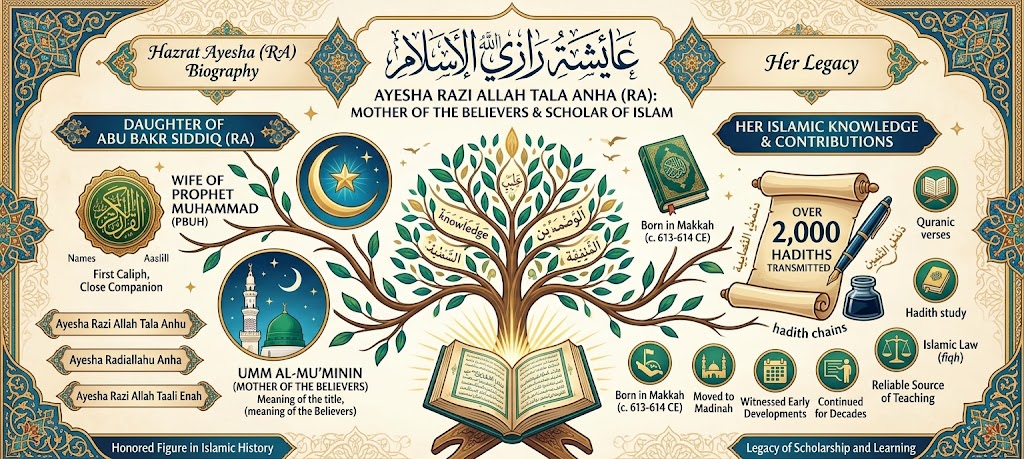
The Ayesha Razi Allah Tala Anhu biography begins in Makkah, where she was born into the Quraysh tribe. Historical sources generally place her birth around 613 or 614 CE, although early biographical details remain limited.
She later married Prophet Muhammad (PBUH) and moved to Madinah. During their life together, she learned about religious practices and witnessed important developments in the Muslim community.
After the Prophet’s death in 632 CE, Ayesha continued teaching Muslims for many years. Her knowledge made her an important authority for scholars and companions who sought guidance.
For readers searching for Hazrat Ayesha Razi Allah Tala Anhu Wikipedia, it is useful to consult established historical references alongside traditional Islamic sources. These sources discuss her family, scholarship, and role in early Muslim history.
Ayesha Razi Allah Tala Anhu Father Name
The answer to Ayesha Razi Allah Tala Anhu father name is Abu Bakr Abdullah ibn Abi Quhafa, commonly known as Abu Bakr Siddiq (RA).
He was a close companion of Prophet Muhammad (PBUH) and became the first caliph after the Prophet’s death. His close relationship with the Prophet also connected Ayesha to important events in early Islamic history.
Her mother was Umm Ruman (RA). Together, her parents belonged to the early Muslim community.
The name Hazrat Ayesha Razi Allah Tala is commonly used in South Asian Islamic writing. Similarly, people use Ayesha Razi Allah Tala and Ayesha Razi Allah Taali Enah when searching for information about her.
However, the standard English transliteration is usually Aisha or Ayesha (RA), with the feminine honorific Radiyallahu Anha, meaning “May Allah be pleased with her.”
Ayesha Razi Allah Tala Anhu Children
A frequently asked question concerns Ayesha Razi Allah Tala Anhu children. Historical accounts state that Ayesha (RA) did not have biological children.
Nevertheless, she became known by the respectful title Umm al-Mu’minin, meaning “Mother of the Believers.” This title applies to the wives of Prophet Muhammad (PBUH), as mentioned in the Quran.
Her position was based on her relationship with the Prophet and her respected status within the Muslim community, not on having biological children.
The name Amma Ayesha Razi Allah Tala Anhu is also used affectionately in some South Asian communities. Here, Amma expresses respect and affection for her status as a Mother of the Believers.
Ayesha Radiallahu Anhu and Her Islamic Knowledge
Although some searches use Ayesha Radiallahu Anhu, the grammatically appropriate feminine form is Radiyallahu Anha.
Ayesha (RA) was renowned for her understanding of the Quran, hadith, Islamic law, and the Prophet’s traditions. Scholars and companions consulted her about religious questions.
She transmitted more than 2,000 hadiths according to commonly cited traditional counts. These narrations cover prayer, purification, family life, worship, and the Prophet’s character.
Furthermore, her scholarship demonstrates the important role women played in preserving Islamic knowledge. Students learned from her, and later scholars relied on the narrations she transmitted.
Who Is Hazrat Ayesha Razi Allah Tala?
For anyone asking who is Hazrat Ayesha Razi Allah Tala, she was a respected scholar, narrator of hadith, and prominent historical figure in the early Muslim community.
Her life also included involvement in political events after the Prophet’s death. One significant event was the Battle of the Camel in 656 CE, which occurred during the conflict surrounding the caliphate of Ali ibn Abi Talib (RA).
This period remains historically and religiously sensitive. Muslims and historians interpret some of these events differently, so readers should approach them with care and reliable sources.
Despite these historical complexities, her influence on Islamic scholarship remains widely recognized.
Hazrat Ayesha Razi Allah Taali Enah: Her Legacy
The legacy of Hazrat Ayesha Razi Allah Taali Enah extends beyond her lifetime. Her narrations preserve details about the Prophet’s worship, behavior, and household life.
Students of Islamic history study her contributions to understand the development of hadith and religious knowledge. Her example also highlights the importance of asking questions, seeking knowledge, and teaching others.
The names Ayesha Razi and Hazrat Ayesha Razi Allah Tala Anhu appear in many online searches, reflecting continued interest in her life and history.
Conclusion
Ayesha Razi Allah Tala Anhu holds a significant place in Islamic history. As the wife of Prophet Muhammad (PBUH), daughter of Abu Bakr Siddiq (RA), and a respected scholar, she helped preserve knowledge for future generations.
Her life remains an important subject for anyone studying Islamic biography, hadith, and the history of Muslim women.
By learning about Hazrat Ayesha (RA), readers can better understand her scholarship, historical significance, and lasting contribution to the Muslim community.