Hazrat Ayesha (RA) was the daughter of Hazrat Abu Bakr As-Siddiq (RA), whose personal name was Abdullah ibn Uthman ibn Amir al-Qurashi. Abu Bakr (RA) was the first Caliph of Islam and the closest companion of Prophet Muhammad ﷺ.
Who Was Hazrat Ayesha (RA)?
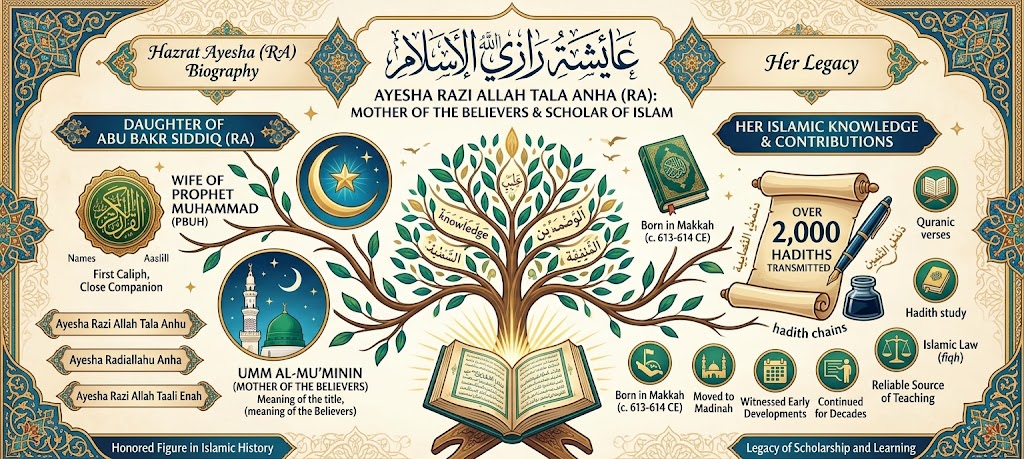
Hazrat Ayesha bint Abu Bakr (RA) is one of the most respected women in Islamic history. She is honored with the title Mother of the Believers (Umm al-Mu’minin) because she was one of the wives of Prophet Muhammad ﷺ. Her intelligence, remarkable memory, and deep understanding of Islam made her one of the greatest scholars among the Companions. She narrated thousands of hadiths and taught many leading scholars after the Prophet’s passing. Islamic historians describe her as a woman whose knowledge benefited generations of Muslims across the world.
What Was the Father Name of Hazrat Ayesha (RA)?
The father of Hazrat Ayesha (RA) was Hazrat Abu Bakr As-Siddiq (RA).
His actual name was:
Abdullah ibn Uthman ibn Amir al-Qurashi al-Taymi
However, he became universally known by his title Abu Bakr and later received the honorific As-Siddiq, meaning “the Truthful,” because he firmly believed and supported Prophet Muhammad ﷺ throughout his mission.
Abu Bakr As-Siddiq (RA)
Abu Bakr (RA) holds an extraordinary position in Islam. He was among the earliest believers and remained the Prophet’s closest friend throughout his life. His unwavering faith, generosity, humility, and leadership earned him immense respect among the Companions. After the Prophet Muhammad ﷺ passed away, Abu Bakr (RA) became the first Rightly Guided Caliph, helping preserve the unity of the Muslim community during a critical period. His leadership laid the foundation for the rapid expansion and stability of the Islamic state.
His Original Name
Although most Muslims know him as Abu Bakr, his birth name was Abdullah ibn Uthman. The name As-Siddiq was bestowed upon him because of his unwavering belief in the Prophet ﷺ, particularly after the miraculous event of Al-Isra’ wal-Mi’raj. His noble character, honesty, and devotion became defining qualities remembered throughout Islamic history.
Family Lineage of Hazrat Ayesha (RA)
Her Mother
Hazrat Ayesha’s (RA) mother was Umm Ruman (RA), whose full name was Umm Ruman bint Amir. She was among the early Muslims and was known for her righteousness and devotion. Islamic historical sources describe her as a pious woman who played an important role in nurturing Ayesha (RA) with strong Islamic values from childhood.
Her Siblings
Hazrat Ayesha (RA) belonged to a distinguished family. Her well-known siblings included:
| Name | Relationship |
|---|---|
| Asma bint Abu Bakr (RA) | Elder sister |
| Abdullah ibn Abu Bakr (RA) | Brother |
| Abdul Rahman ibn Abu Bakr (RA) | Brother |
| Muhammad ibn Abu Bakr (RA) | Half-brother |
| Umm Kulthum bint Abu Bakr (RA) | Half-sister |
Many members of this blessed family played important roles in the early history of Islam.
Why Abu Bakr (RA) Is So Important in Islam
First Adult Male to Accept Islam
Islamic tradition records Abu Bakr (RA) among the earliest adults to embrace Islam. His acceptance of Islam encouraged many influential companions to enter the faith, strengthening the young Muslim community during its earliest days. His trust in Prophet Muhammad ﷺ never wavered despite intense persecution in Makkah.
Companion During the Hijrah
One of the greatest honors given to Abu Bakr (RA) was accompanying Prophet Muhammad ﷺ during the migration (Hijrah) from Makkah to Madinah. Together they stayed in the Cave of Thawr while escaping persecution, an event mentioned in the Qur’an and remembered as a symbol of trust in Allah and steadfast friendship.
First Caliph
Following the Prophet’s death, Abu Bakr (RA) became the first Caliph. His leadership helped preserve unity, address internal challenges, and ensure the continued spread of Islam. His brief but impactful caliphate remains one of the most admired periods of Islamic governance.
Relationship Between Prophet Muhammad ﷺ and Abu Bakr (RA)
The relationship between Prophet Muhammad ﷺ and Abu Bakr (RA) was built upon trust, loyalty, and shared sacrifice. Abu Bakr (RA) supported the Prophet ﷺ with his wealth, wisdom, and unwavering companionship from the earliest days of Islam. The marriage of Prophet Muhammad ﷺ to Ayesha (RA) further strengthened this noble bond between the two families. Throughout Islamic history, scholars have highlighted this relationship as an example of sincere friendship rooted in faith and devotion.
The Upbringing of Hazrat Ayesha (RA)
Growing up in the household of Abu Bakr (RA), Ayesha (RA) received an exceptional upbringing. Her home was one of the first Muslim homes in Makkah, filled with faith, honesty, and devotion to Allah. From an early age she witnessed the sacrifices made for Islam, shaping her remarkable personality. Her intelligence, sharp memory, and curiosity enabled her to become one of the foremost authorities on Islamic teachings after the Prophet ﷺ.
Knowledge and Scholarship of Hazrat Ayesha (RA)
Hadith Narrations
Hazrat Ayesha (RA) narrated approximately 2,210 hadiths, making her one of the most prolific narrators in Islamic history. Her narrations cover worship, family life, ethics, medicine, inheritance, and many other aspects of Islam. These narrations continue to guide Muslims and are included in the major collections of hadith.
Islamic Jurisprudence
Beyond narrating hadith, Ayesha (RA) was also recognized as an expert in Islamic law (fiqh). Senior companions and later scholars frequently sought her opinions on complex legal and religious matters. Her balanced reasoning, exceptional memory, and close companionship with the Prophet ﷺ made her one of the greatest female scholars in Islamic history. Her contributions continue to be studied in Islamic universities and seminaries worldwide.
Conclusion
The answer to “Ayesha Razi Allah Tala Anha father name” is clear:
Hazrat Ayesha (RA) was the daughter of Hazrat Abu Bakr As-Siddiq (RA), whose actual name was Abdullah ibn Uthman ibn Amir al-Qurashi. He was the closest companion of Prophet Muhammad ﷺ, the first Caliph of Islam, and one of the greatest figures in Islamic history. Growing up in such a noble household greatly influenced Ayesha (RA), enabling her to become one of the most knowledgeable and respected women in Islam. Her legacy continues through the thousands of hadiths she narrated and the invaluable knowledge she passed on to future generations.
FAQs
1. What was the father name of Hazrat Ayesha (RA)?
Her father was Hazrat Abu Bakr As-Siddiq (RA), whose personal name was Abdullah ibn Uthman ibn Amir al-Qurashi.
2. Who was the mother of Hazrat Ayesha (RA)?
Her mother was Umm Ruman (RA).
3. What title was given to Abu Bakr (RA)?
He was given the title As-Siddiq, meaning “The Truthful.”
4. How many hadiths did Hazrat Ayesha (RA) narrate?
She narrated approximately 2,210 hadiths.
5. Why is Hazrat Ayesha (RA) important in Islam?
She was one of the greatest scholars among the Companions, a major narrator of hadith, and one of the Mothers of the Believers whose teachings continue to benefit Muslims worldwide.
One Comment on “Hazrat Ayesha (RA) Father Name: The Complete Guide to the Family of Aisha bint Abu Bakr (RA)”
Comments are closed.