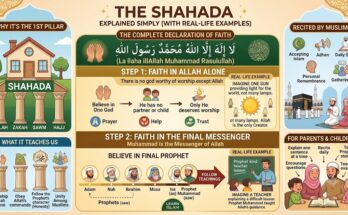
When someone begins learning about Islam, one of the first concepts they encounter is Shahadah, the testimony of faith. It is not simply a sentence that Muslims memorize, repeat, or teach to children. Shahadah is the foundation upon which a Muslim’s understanding of Allah, worship, purpose, and relationship with Prophet Muhammad ﷺ is built. The word itself is connected with bearing witness or giving testimony, and in Islam it refers to affirming that there is no deity worthy of worship except Allah and that Muhammad ﷺ is His Messenger. The importance of this testimony becomes much clearer when we understand that the other major acts of worship in Islam are connected to the faith expressed through it. A Muslim prays because of belief in Allah, gives Zakah because of obedience to Allah, fasts because Allah has commanded fasting, and performs Hajj because of submission to Allah. In this sense, Shahadah is the starting point of the entire Islamic framework. The Prophet Muhammad ﷺ described Islam as being built upon five pillars, beginning with the testimony of faith.
What Is the First Pillar of Islam?
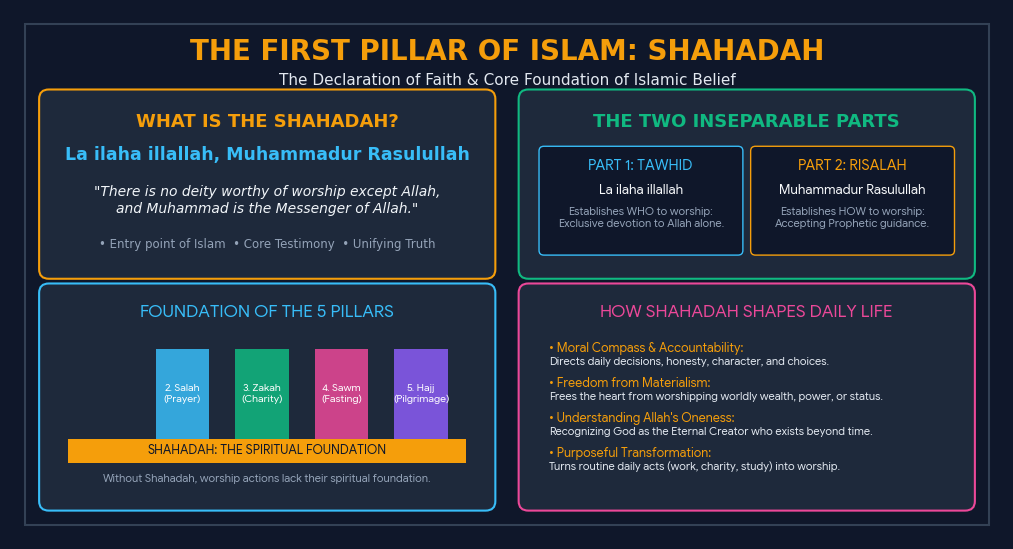
The first pillar of Islam is Shahadah, also commonly written as Shahada. It is the declaration that there is no deity worthy of worship except Allah and that Muhammad ﷺ is the Messenger of Allah. This testimony establishes the two central foundations of Islamic belief: Tawhid, the absolute oneness and uniqueness of Allah, and acceptance of Muhammad ﷺ as Allah’s final Messenger. The Shahadah is therefore much deeper than merely identifying oneself as Muslim. It represents a fundamental commitment to worship Allah alone and to accept the guidance brought by His Messenger. The famous wording begins with La ilaha illallah, meaning that there is no deity worthy of worship except Allah, followed by the testimony that Muhammad ﷺ is the Messenger of Allah. The first part rejects the worship of anything besides Allah, while the second part establishes the authority of the Prophet ﷺ in conveying and teaching Islam. A person who understands Shahadah begins to see Islam not as a collection of unrelated religious practices but as a complete way of life built around submission to the One God. This is why Shahadah stands at the beginning of the five pillars rather than somewhere in the middle.
Shahadah Meaning in Islam
The word Shahadah is commonly translated as “testimony,” “testification,” or “bearing witness.” In the Islamic context, it means affirming a fundamental truth of faith with conviction. The testimony is not intended to be an empty statement. Its meaning should enter the heart and influence a person’s choices, worship, character, and understanding of life. When a Muslim says La ilaha illallah, the statement carries a powerful implication: worship belongs to Allah alone. It means that no created being, object, human authority, wealth, status, or worldly power deserves the worship that belongs exclusively to Allah. The second part, affirming Muhammad ﷺ as Allah’s Messenger, means accepting the Prophet’s teachings and guidance as part of the path of Islam. This is why the Shahadah can be viewed as both a statement of belief and a declaration of allegiance to a particular way of living. It changes the answer to a fundamental human question: “Who do I worship, and whose guidance do I follow?” Islam answers that question through the Shahadah. The Qur’an repeatedly emphasizes Allah’s uniqueness, including the statement that God is One and that there is no deity worthy of worship except Him.
The Shahada Profession of Faith
The phrase Shahada profession of faith refers to the declaration through which a person expresses the central beliefs of Islam. The word “profession” here does not mean a job or occupation; it means an open declaration or affirmation. In many introductory explanations of Islam, Shahadah is therefore described as the Muslim profession of faith. It is often taught to new Muslims as the foundational declaration that establishes their entry into Islam when sincerely accepted and pronounced according to Islamic requirements. However, reducing Shahadah to a verbal formula misses an important part of its significance. Islamic faith involves conviction, acceptance, and submission, not merely the mechanical pronunciation of words. Someone may memorize a sentence without understanding it, while the purpose of Shahadah is to affirm a profound belief about Allah and His Messenger. For that reason, Muslims traditionally teach children the meaning of the Shahadah alongside its wording. A child should gradually understand that Allah alone is worthy of worship and that Muhammad ﷺ brought Allah’s guidance. In everyday Muslim life, the Shahadah also serves as a constant reminder of identity and purpose. It answers the most basic spiritual questions: Who is my Creator? Who deserves my worship? What guidance should I follow? And what principles should shape my life?
The Two Parts of the Shahadah
The Shahadah contains two essential declarations, and each has a distinct meaning while remaining inseparable from the other. The first declaration is the testimony that there is no deity worthy of worship except Allah. This is the heart of Tawhid, the belief that Allah is absolutely One and has no partner in worship. The second declaration affirms that Muhammad ﷺ is the Messenger of Allah. This means that Muslims accept the Prophet ﷺ as the Messenger who conveyed Allah’s revelation and taught people how to live according to it. The two parts therefore answer two different but connected questions. The first establishes Who should be worshipped, while the second establishes whose prophetic guidance is accepted. If a person claims belief in Allah but rejects the message of Muhammad ﷺ, that does not represent the complete testimony of Islamic faith. Likewise, merely accepting Muhammad ﷺ as a historical figure without believing in Allah’s exclusive right to worship does not fulfill the meaning of Shahadah. This two-part structure gives the testimony remarkable depth. It combines belief in the One God with acceptance of the Messenger who communicated divine guidance. The classical wording of the five pillars in authentic hadith explicitly includes both elements: testifying that there is no deity worthy of worship except Allah and that Muhammad ﷺ is His servant and Messenger.
Why Is Shahadah Important?
Why is Shahadah important? The simplest answer is that it defines the foundation of Islamic belief. Every major act of worship in Islam is ultimately connected to the belief expressed in Shahadah. Salah is not merely physical movement; it is worship directed toward Allah. Zakah is not merely financial redistribution; it is an act of obedience and purification performed because Allah has commanded it. Sawm is not simply going without food and drink; it is worship performed for Allah and designed to develop consciousness of Him. Hajj is not merely travel to Makkah; it is an act of worship connected to submission, obedience, and remembrance of Allah. Shahadah gives all of these actions their spiritual direction. Without the foundation of faith, religious practices can become disconnected routines. With Shahadah, they become expressions of a person’s relationship with Allah. This is one reason the testimony is placed first among the five pillars. It establishes the foundation before the practical structure is built. A useful analogy is a building: prayer, Zakah, fasting, and Hajj are major structural elements, but the declaration of faith establishes the spiritual foundation on which the Muslim’s religious life rests. The Prophet ﷺ explicitly described Islam as being built upon five pillars, beginning with the testimony of faith.
Shahadah and the Oneness of Allah
At the center of Shahadah is the concept of Tawhid, the oneness of Allah. Islam teaches that Allah is not one god among many competing gods. Rather, Allah alone is worthy of worship, and He has no partner, equal, or rival. The Qur’an expresses this concept clearly by declaring that the God of humanity is One and that there is no deity worthy of worship except Him. This belief changes the way a Muslim understands the world. Wealth may be useful, but it is not worthy of worship. People may deserve respect, love, and kindness, but they are not objects of worship. Governments, celebrities, possessions, careers, and social status may influence human life, but they cannot take the place of Allah. Tawhid therefore liberates a person from treating created things as ultimate authorities over the heart. This is one of the profound meanings behind La ilaha illallah. The statement does not simply mean that Muslims believe Allah exists; belief in Allah’s existence is only part of the broader concept. It means that worship, ultimate devotion, and religious submission belong to Allah alone. When this understanding becomes deeply rooted, Shahadah stops being merely something spoken by the tongue and becomes a principle that influences how a Muslim thinks about fear, hope, success, hardship, morality, and the purpose of life.
How Old Is Allah? Understanding Allah Beyond Time
A common question searched online is “how old is Allah?” From an Islamic perspective, this question is based on an assumption that does not apply to Allah. Human beings have ages because humans are created, born at particular points in time, and undergo change. Allah, however, is the Creator and is not understood in Islam as a created being who came into existence at a particular moment. Therefore, Muslims do not calculate Allah’s age in years, centuries, or billions of years. Asking how old Allah is is somewhat like asking what date existed before time itself; the framework of the question does not fit the subject. Islamic belief describes Allah as eternal and independent of creation. This is closely connected to Shahadah because the first part of the testimony is about recognizing Allah as the only One worthy of worship. The Muslim does not worship a created object, ancestor, natural force, or human being. The object of worship is the Creator. Understanding this distinction is especially important when teaching children because they naturally ask questions using human categories. Parents and teachers can explain that everything we see in creation has a beginning and depends upon something, whereas Allah is the Creator and is not dependent upon creation. The goal is not to imagine Allah as an extremely old human-like being, but to understand that Allah’s existence is fundamentally different from created existence.
The Five Pillars of Islam
The five pillars of Islam are Shahadah, Salah, Zakah, Sawm, and Hajj. Shahadah is the testimony of faith; Salah refers to the prescribed prayers; Zakah is obligatory charity; Sawm refers particularly to fasting during Ramadan; and Hajj is the pilgrimage to the Ka’bah for those who are able to undertake it. These five pillars provide a practical framework for Muslim religious life. The Prophet Muhammad ﷺ described Islam as being built upon five, and authentic narrations list the testimony, prayer, Zakah, Ramadan fasting, and pilgrimage. The pillars are not five unrelated religious customs. Together they connect belief, worship, financial responsibility, self-discipline, community, and devotion to Allah. Shahadah establishes belief. Salah creates a regular daily connection with Allah. Zakah reminds Muslims that wealth carries responsibilities toward others. Sawm trains discipline and God-consciousness, while Hajj demonstrates submission and unity through a major act of worship. Their order also makes sense: the testimony comes first because it establishes the faith that gives the other acts their Islamic identity. A Muslim should therefore learn the pillars not simply as a list to memorize for a test but as a framework for understanding how Islam shapes both belief and practice.
Five Pillars of Islam in a Sentence
If you need to explain the five pillars of Islam in a sentence, you can say: The five pillars of Islam are Shahadah, Salah, Zakah, Sawm, and Hajj, representing faith in Allah and His Messenger, prayer, obligatory charity, fasting in Ramadan, and pilgrimage to Makkah for those who are able. This sentence is useful for students, beginners, and anyone looking for a simple overview of Islamic practice. However, a sentence alone cannot communicate the full depth of each pillar. Shahadah involves the foundation of belief, while Salah structures a Muslim’s daily worship. Zakah establishes a responsibility toward eligible recipients, Sawm develops discipline and God-consciousness, and Hajj brings together worshippers in one of Islam’s most significant acts of pilgrimage. The five pillars can therefore be remembered as a framework moving from foundational belief toward repeated acts of worship and major obligations. The Prophet’s description of Islam being built on five pillars gives this structure its classical foundation. For a child, the five pillars can initially be taught through a simple sentence and visual learning. As the child grows, each pillar can then be explored through its meaning, rules, purpose, and practical application. This gradual approach is much more effective than asking students to memorize names without understanding what those names represent.
Sawm and the Five Pillars
Sawm, or fasting, is the fourth of the commonly listed five pillars of Islam. Muslims particularly associate Sawm with fasting during the month of Ramadan, when adult Muslims who are able are required to fast from dawn until sunset according to Islamic rules. The Qur’an directly addresses believers regarding fasting and explains that fasting was prescribed so that they may develop Taqwa, often translated as God-consciousness or mindfulness of Allah. This gives fasting a purpose far beyond hunger. During the fast, a Muslim voluntarily leaves food and drink during the prescribed period while remembering Allah and controlling desires. The experience can strengthen patience, discipline, gratitude, empathy, and awareness of one’s dependence upon Allah. Sawm also demonstrates how the five pillars are connected to Shahadah. A Muslim fasts because he or she believes in Allah and accepts His command. In that sense, the declaration of faith becomes visible through action. Someone who says that Allah is the One worthy of worship is expected to respond to Allah’s commands with obedience. This relationship between belief and practice is important when explaining Islam to beginners. The pillars are not merely boxes that Muslims check. They are practices through which the beliefs expressed by Shahadah are lived out in real life.
Why Are the Five Pillars Important to Islam?
Why are the 5 pillars important to Islam? They are important because they provide a foundational structure for Muslim belief and worship. Think of them as major supports holding up a structure: each has its own function, but together they create a recognizable framework of Islamic religious life. Shahadah establishes the foundation of faith, Salah provides regular worship throughout the day, Zakah creates financial responsibility, Sawm develops discipline and God-consciousness, and Hajj represents a major act of worship and pilgrimage for those who are able. The five pillars also prevent Islam from becoming only an abstract belief system. A Muslim’s faith is expressed through repeated actions, sacrifice, generosity, discipline, and worship. The Prophet Muhammad ﷺ explicitly described Islam as being built upon these five principles, which demonstrates their central importance. At the same time, the five pillars do not represent every Islamic teaching. Islam also includes belief in Allah’s angels, books, messengers, the Last Day, divine decree, moral conduct, family responsibilities, justice, honesty, and countless other teachings. The pillars are therefore foundational rather than exhaustive. Understanding this distinction helps prevent a common mistake: thinking that being Muslim means merely performing five actions. The pillars provide the essential framework, while the wider Islamic teachings shape a Muslim’s character and entire way of life.
Pillar of Islam in Arabic
The phrase pillar of Islam in Arabic can be expressed as رُكْنٌ مِنْ أَرْكَانِ الْإِسْلَامِ for “a pillar among the pillars of Islam,” while the plural phrase أَرْكَانُ الْإِسْلَامِ means “the pillars of Islam.” Shahadah itself is written الشَّهَادَة. The five pillars are commonly identified through Arabic terms: الشَّهَادَة (Shahadah), الصَّلَاة (Salah), الزَّكَاة (Zakah), الصَّوْم (Sawm), and الحَجّ (Hajj). Learning these Arabic terms can help students connect English explanations with the original Islamic vocabulary. However, memorizing Arabic words should not replace understanding their meanings. For example, a student may know that Sawm means fasting but still need to learn when fasting is obligatory, what invalidates it, who receives concessions, and why fasting is spiritually important. Similarly, knowing the word Shahadah is only the beginning. The student should understand that it means testimony and should know what the testimony affirms. Arabic terminology is especially useful when studying Qur’an, Hadith, Islamic studies, and traditional scholarship because many concepts cannot always be captured perfectly by one English word. For beginners, a useful method is to teach the Arabic term, its English meaning, and then its practical significance. This creates a stronger understanding than simple vocabulary memorization.
How Shahadah Shapes a Muslim’s Daily Life
Shahadah should influence much more than what a Muslim says during religious instruction. If a person genuinely believes that Allah alone deserves worship, that belief should gradually affect everyday decisions. It can influence how someone responds to success, because success is understood as a blessing rather than a reason for arrogance. It can influence how someone responds to hardship, because difficulties are experienced while maintaining trust in Allah. It can influence business behavior, because honesty matters even when dishonesty might appear financially profitable. It can influence relationships because Muslims understand that people have rights and responsibilities before Allah. In this way, Shahadah becomes a compass, not merely a sentence. A compass does not walk for you, but it tells you which direction you should travel; similarly, Shahadah does not remove every difficult decision, but it gives the believer a foundational direction. When a Muslim faces a choice between something clearly right and something clearly wrong, the testimony of faith reminds the person that ultimate accountability belongs to Allah. This is why Islamic education should not stop after teaching the wording of Shahadah. The deeper goal is to develop understanding so that the belief gradually appears in character, worship, decision-making, and relationships.
Shahadah and Becoming a Muslim
For someone entering Islam, the Shahadah has enormous significance because it expresses the central beliefs that define Islamic faith. A person who sincerely accepts Islam believes in Allah’s oneness and accepts Muhammad ﷺ as His Messenger. The declaration is therefore not comparable to signing up for a social club or simply changing a label. It represents a fundamental change in worldview and religious commitment. A new Muslim may have many questions after learning the Shahadah, and that is completely understandable. Learning Salah, understanding purification, studying the Qur’an, learning basic Islamic beliefs, and developing knowledge of Islamic manners can happen gradually. New Muslims should not assume that they need to understand every detail of Islamic scholarship before beginning their journey. At the same time, Shahadah should not be treated as a casual phrase. Its meaning deserves serious reflection because it establishes the central direction of Islamic life. A supportive learning environment can make a significant difference during this stage. Teachers, family members, and communities can help new Muslims understand the practical consequences of their declaration while avoiding unnecessary pressure. The beginning of a Muslim’s journey should be characterized by learning, worship, patience, and a growing relationship with Allah.
Common Misunderstandings About Shahadah
There are several misunderstandings about Shahadah that can make the subject confusing for beginners. One mistake is thinking that Shahadah means simply saying a sentence without believing what it means. Another is assuming that believing Allah exists is the entire meaning of the testimony. Islamic Shahadah is more specific: it affirms Allah’s exclusive right to worship and recognizes Muhammad ﷺ as His Messenger. Another misunderstanding is thinking that the five pillars are the entire religion of Islam. They are foundational pillars, but Islam also includes extensive teachings concerning belief, ethics, family, justice, charity, personal conduct, and community life. Some people also confuse Shahadah with general statements of Muslim identity. The Shahadah is a formal theological declaration with specific meaning. Another common mistake is translating “La ilaha illallah” too loosely as simply “there is one God.” While that communicates part of the idea, the fuller meaning emphasizes that none is worthy of worship except Allah. Precision matters because Islamic concepts often carry theological meanings that cannot be reduced to a few English words. The best approach is therefore to teach the Arabic wording together with a clear explanation of its meaning and implications.
Teaching Shahadah to Children
Teaching Shahadah to children should focus on understanding before demanding complicated explanations. Young children can first learn that Allah created them, provides for them, and alone deserves worship. They can then learn that Prophet Muhammad ﷺ was Allah’s Messenger and taught people how to worship Allah correctly. The Arabic wording can be introduced gradually, followed by an age-appropriate explanation. For very young children, examples from everyday life are often more effective than technical theological discussions. A parent might explain that when Muslims pray, they pray to Allah alone because of what they believe in Shahadah. When older children ask questions such as “Why can’t we see Allah?” or “Who created Allah?”, those questions should be handled calmly rather than dismissed. The goal is to build a strong foundation of faith and curiosity. Children also learn through observing adults, so parents should understand that their own behavior is part of Islamic education. If adults teach children that Allah is One but behave dishonestly, aggressively, or disrespectfully, the lesson becomes contradictory. Teaching Shahadah successfully therefore involves words, worship, behavior, stories, questions, and consistent examples. A good Islamic teacher helps children move from memorization to understanding and eventually from understanding to practice.
Shahadah and Spiritual Transformation
The deepest value of Shahadah appears when it transforms the way a person sees life. Before understanding Tawhid, a person may allow money, reputation, fear of people, or worldly success to become the center of existence. Shahadah redirects the heart toward Allah. It teaches that created things may be important, but none of them is worthy of the worship and ultimate submission owed to the Creator. This can produce a profound form of inner freedom. A Muslim can work hard for success without making success an object of worship. A person can love family without treating family as greater than Allah’s commands. A person can respect leaders without believing that human authority is absolute. Shahadah therefore establishes a hierarchy of values. Allah comes first, and everything else is understood within that relationship. This does not mean Muslims should abandon worldly responsibilities. On the contrary, Islamic faith calls people toward responsible living, honesty, justice, compassion, and fulfilling obligations. The spiritual transformation occurs because ordinary actions acquire a different purpose. Eating, working, studying, raising children, earning money, helping others, and resting can all become connected to obedience when performed within an Islamic framework. Shahadah is therefore not merely the door through which someone enters Islam; it is a principle that continues to shape the believer after entering.
Shahadah, Responsibility, and Accountability
A declaration of faith also creates responsibility. If someone says that Allah alone deserves worship, then that person accepts that life has a moral direction established by Allah. If someone testifies that Muhammad ﷺ is Allah’s Messenger, then accepting his teachings becomes part of that commitment. This does not mean a Muslim becomes perfect after saying Shahadah. Human beings make mistakes, struggle with desires, forget, and sometimes fall into sin. Islam provides concepts such as repentance, forgiveness, patience, and returning to Allah precisely because human beings are imperfect. The significance of Shahadah is that it establishes the believer’s fundamental orientation even when the person struggles. A Muslim who makes a mistake is not expected to abandon faith; rather, the person is encouraged to repent and return to obedience. Shahadah also creates accountability because Islamic belief includes the understanding that human life is not meaningless or without consequence. Actions matter. Character matters. Worship matters. How someone treats other people matters. This is why the five pillars should never be taught as isolated rituals. Their deeper purpose is connected to a believer’s relationship with Allah and the moral life that follows from that relationship. Shahadah establishes the foundation from which those responsibilities are understood.
Conclusion
Shahadah is the first pillar of Islam because it establishes the foundation upon which the rest of Islamic practice is built. Its central message is that Allah alone is worthy of worship and that Muhammad ﷺ is His Messenger. From this foundation come the other pillars: Salah, Zakah, Sawm, and Hajj. The testimony therefore connects belief with action, theology with worship, and conviction with daily life. Understanding Shahadah also helps answer many related questions, including why the five pillars matter, what Sawm means, why Muslims say Radhiyallahu Anhu after a Companion’s name, and why Muslims believe Allah cannot be described in terms of a human age. The strongest way to teach the Shahadah is not simply to memorize its Arabic wording but to understand what each part means and how that meaning affects a person’s choices. The Prophet Muhammad ﷺ identified the five pillars as the foundational structure of Islam, placing the testimony of faith at the beginning. For a beginner, Shahadah is the starting point; for a lifelong Muslim, it remains a statement whose meaning continues to shape worship, character, and purpose.
Frequently Asked Questions
1. What is the first pillar of Islam?
The first pillar of Islam is Shahadah, the testimony of faith. It affirms that there is no deity worthy of worship except Allah and that Muhammad ﷺ is the Messenger of Allah. It establishes the foundation of Islamic belief and comes before Salah, Zakah, Sawm, and Hajj.
2. Why is Shahadah important in Islam?
Shahadah is important because it establishes the two central foundations of Islamic faith: the oneness of Allah and acceptance of Muhammad ﷺ as His Messenger. The other pillars of Islam are practiced from within this foundation. The Prophet ﷺ described Islam as being built upon five pillars, beginning with the testimony of faith.
3. What does Shahada mean in Islam?
Shahada means testimony or bearing witness. In Islamic terminology, it refers to affirming that Allah alone is worthy of worship and that Muhammad ﷺ is His Messenger. It is more than memorizing words because its meaning involves belief and commitment.
4. What are the five pillars of Islam?
The five pillars are Shahadah, Salah, Zakah, Sawm, and Hajj. They represent the testimony of faith, prayer, obligatory charity, fasting during Ramadan, and pilgrimage to the Ka’bah for those who are able. This structure is established in authentic hadith.
5. How old is Allah according to Islam?
Allah does not have an age in the human sense. Muslims believe Allah is the Creator and is not a created being who began existing at a particular point in time. Therefore, asking for Allah’s age does not apply in the same way that age applies to human beings or other created things.