If you ask, “How old is the religion of Islam?”, the simplest answer is this: Islam began as a historical religious community in 7th-century Arabia, with the beginning of Muhammad‘s revelations around 610 CE. That means Islam, as a historically identifiable religious community, is about 1,416 years old in 2026.How Old Is the Religion of Islam?
But there is an important detail that makes the answer more interesting. Muslims do not generally understand Islam as a completely new religion invented in the 7th century. According to Islamic belief, Islam is the continuation and completion of the same basic message taught by earlier prophets, including Adam, Noah, Abraham, Moses, and Jesus. So there are really two ways of answering the question: the historical answer and the theological answer. Historically, Islam emerged in Arabia in the 600s CE; religiously, Muslims believe its message goes all the way back to the beginning of humanity.
The Simple Answer
Historically, Islam developed in Arabia during the 7th century CE. The Smithsonian’s National Museum of Asian Art describes Islam as a monotheistic religion that developed in Arabia in the seventh century.
The central figure in the historical emergence of Islam is Muhammad, who Muslims believe was the final prophet sent by God. Muhammad was born in Mecca around 570 CE and died in Medina in 632 CE.
Think of it like the beginning of a long story. The story of Islam as a recognizable historical community begins in Arabia in the 600s, but Muslims believe the message inside that story is much older.
What Happened in 610 CE?
Around 610 CE, Muhammad was about 40 years old. According to Islamic tradition, he was spending time in contemplation in the Cave of Hira near Mecca when he received the first revelation from God through the Angel Gabriel.
This event is considered the beginning of Muhammad’s prophetic mission and the beginning of the Quranic revelation. The Smithsonian states that the Quran was revealed to Muhammad through Gabriel beginning around 610 and continuing until Muhammad’s death in 632.
You can imagine the process as a teacher giving lessons over many years rather than handing someone an entire textbook in one day. The Quran was revealed gradually, addressing belief, worship, morality, family life, justice, community, and many other subjects.
How the Quran Connects to Islam’s Beginning
The Quran is the central scripture of Islam. Muslims believe it is the word of God revealed to Muhammad rather than a book Muhammad personally composed.
According to the Smithsonian, the revelations began around 610 CE and continued until Muhammad died in 632 CE. The revelations were transmitted orally and also written down, and the Quran became established in written form in the decades following Muhammad’s death.
This gives us a useful timeline. If the first revelation occurred around 610 CE and Muhammad died in 632 CE, the Quranic revelation occurred over roughly 22 years.
So when someone says, “Islam is 1,400 years old,” they are usually talking about the historical beginning of Islam’s prophetic mission and Muslim community.
Was Islam a Completely New Religion?
This is where the answer changes depending on whether we are talking about history or Islamic belief.
From a historical perspective, Islam emerged as a distinct religious movement in 7th-century Arabia. From the Islamic theological perspective, however, Islam did not begin with Muhammad in the sense of creating a completely new message.
Muslims believe that God sent prophets throughout human history with the fundamental message of worshipping one God and living according to His guidance. Muhammad is understood as the final prophet, while earlier figures such as Abraham, Moses, and Jesus are also regarded as prophets.
So a Muslim might explain it this way: Muhammad did not bring a completely different God or a completely unrelated religious message. He brought the final revelation in a chain of revelations.
That distinction is important because it explains why Islam refers so frequently to earlier prophets and religious figures.
Why Is 622 CE Important?
Another extremely important date is 622 CE.
In that year, Muhammad and his followers migrated from Mecca to Medina. This migration is known as the Hijrah. It became such an important event that the Islamic calendar uses the Hijrah as its starting point.
In other words, 610 CE marks the beginning of Muhammad’s revelations, while 622 CE marks the beginning of the Islamic calendar. These dates should not be confused.
The migration also transformed the small Muslim community into an organized community in Medina. The Smithsonian notes that the first Muslim community emerged in Arabia during the 7th century.
How Islam Spread
After Muhammad’s death in 632 CE, Islam did not disappear. Instead, the Muslim community continued to grow under his successors.
During the following centuries, Muslim rule expanded across large parts of Southwest Asia, North Africa, and eventually parts of Europe. Britannica describes the early caliphate as expanding rapidly during its first two centuries.
However, political expansion and the spread of a religion are not exactly the same thing. Islam also spread through preaching, scholarship, trade, migration, and conversion. The Smithsonian notes that scholars, merchants, and other believers played important roles in the spread of Islam.
This is one reason Islam eventually became a global religion rather than remaining limited to Arabia.
How Old Is Islam Today?
If we use 610 CE as the approximate beginning of the Islamic revelation, then in 2026 Islam is approximately 1,416 years old.
The calculation is simple:
2026 − 610 = 1,416 years
If you instead use 622 CE, the beginning of the Islamic calendar, then the calculation is:
2026 − 622 = 1,404 years
So you may see slightly different numbers depending on what someone means by “the age of Islam.”
The safest simple explanation is: Islam is about 1,400 years old as a historically identifiable religion, with its origins in 7th-century Arabia.
Islam’s Core Beliefs
Islam is built around belief in one God, known in Arabic as Allah. Muslims believe Muhammad is God’s final prophet and that the Quran is God’s revelation.
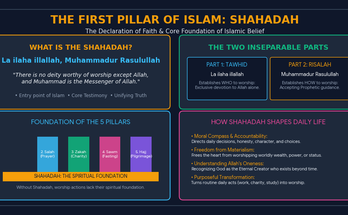
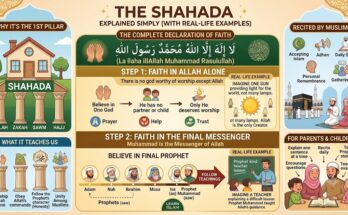
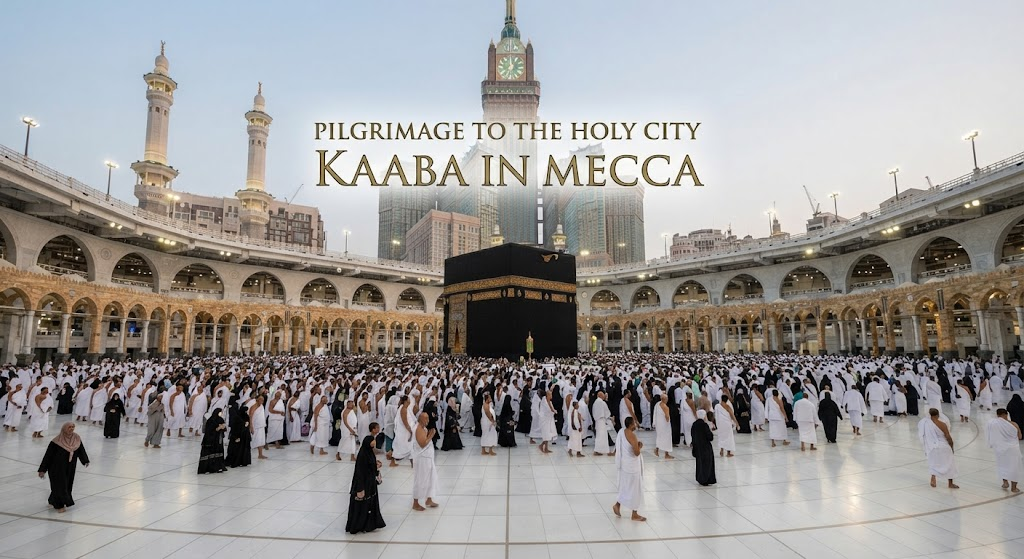
Islam also has five central practices commonly called the Five Pillars of Islam: the declaration of faith, five daily prayers, charitable giving, fasting during Ramadan, and pilgrimage to Mecca for those who are able to perform it. The Smithsonian’s National Museum of African American History and Culture describes these as the five pillars.
For a child, you could think of these pillars like the main supporting columns of a building. A building can contain thousands of other details—doors, windows, rooms, decorations—but the pillars provide its basic structure.
Islam’s History in Simple Terms
Here is the whole story in a very simple timeline:
| Year | Important Event |
|---|---|
| c. 570 CE | Muhammad is born in Mecca |
| c. 610 CE | First Quranic revelation |
| 622 CE | Hijrah: migration from Mecca to Medina |
| 632 CE | Muhammad dies in Medina |
| 7th–8th centuries | Muslim communities and political rule expand beyond Arabia |
| 2026 CE | Islam is approximately 1,400 years old historically |
The dates around Muhammad’s life come from traditional and historical sources, while the exact dating of some early events can be discussed differently by historians. The broad historical picture, however, places the emergence of Islam firmly in 7th-century Arabia.
Conclusion
So, how old is Islam? The easiest answer is about 1,400 years old.
Historically, Islam emerged in 7th-century Arabia, with Muhammad’s first revelations traditionally dated to around 610 CE. Muhammad continued receiving revelations until his death in 632 CE, and the migration to Medina in 622 CE became the starting point of the Islamic calendar.
But there is another side to the answer. Muslims believe Islam’s fundamental message—submission to the one God—did not begin with Muhammad. They believe it was the message of God’s prophets throughout human history, with Muhammad bringing the final revelation.
That is why the answer can be both “about 1,400 years” historically and “as old as humanity” in Islamic theological understanding.
FAQs
1. Did Islam start 1,400 years ago?
Historically, Islam emerged as a distinct religious community in 7th-century Arabia, with the first revelations to Muhammad traditionally dated to around 610 CE. So, in 2026, it is roughly 1,400 years old.
2. Who started Islam?
From a historical perspective, Muhammad is the central figure in the emergence of Islam. Muslims, however, believe Muhammad did not invent the religion but was the final prophet in a long line of prophets sent by God.
3. What year did the Quran first come to Muhammad?
According to Islamic tradition, the first Quranic revelation came around 610 CE, when Muhammad was about 40 years old. The revelations continued until his death in 632 CE.
4. Why does the Islamic calendar start in 622?
The Islamic calendar begins with the Hijrah, Muhammad’s migration from Mecca to Medina in 622 CE. This event was a major turning point for the early Muslim community.
5. Is Islam older than Christianity?
No, if we are comparing the historical emergence of the religions as distinct communities, Christianity predates Islam by about six centuries. However, Islam teaches that its fundamental message of worshipping one God continues the messages of earlier prophets, including Jesus and other figures recognized in the Bible.