Islam is built on five important acts of worship known as the Five Pillars of Islam. Think of them as the foundation of a house. If the foundation is strong, the house stands strong. In the same way, these five pillars help Muslims build a strong relationship with Allah and live a life filled with faith, kindness, and purpose.
Whether you’re teaching your child, learning Islam for the first time, or simply refreshing your knowledge, this guide explains the Five Pillars in simple language with everyday examples.
What Are the Five Pillars of Islam?
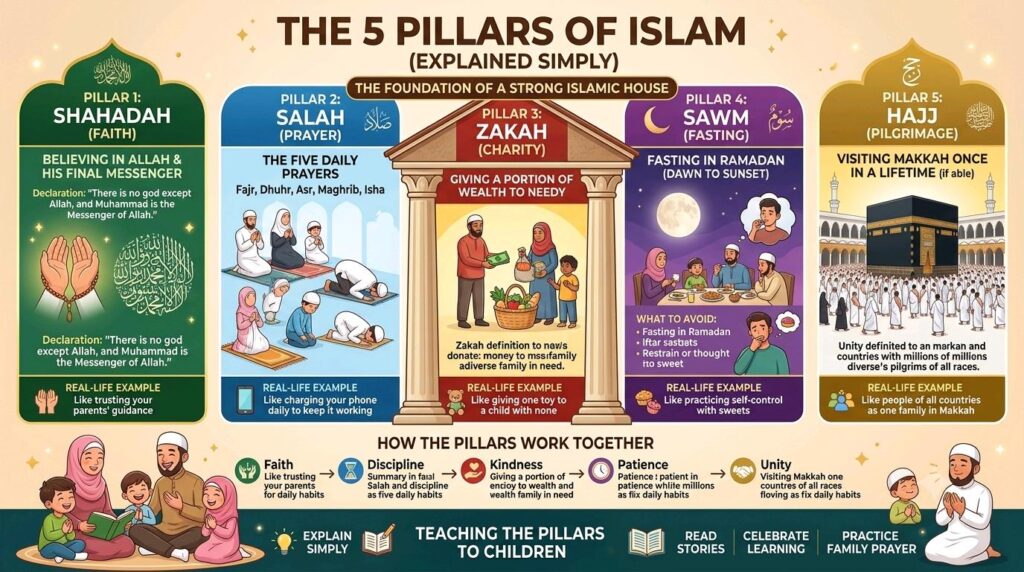
The Five Pillars are the basic acts of worship that every Muslim should practice. They teach us to believe in Allah, pray regularly, help those in need, fast during Ramadan, and perform Hajj if we are able.
These pillars help Muslims grow spiritually and become better members of their families and communities.
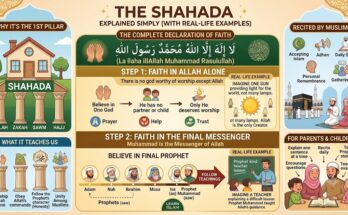
Pillar 1: Shahadah (Faith)
Meaning: Believing that there is only one God (Allah) and that Prophet Muhammad (ﷺ) is His final Messenger.
Declaration:
“There is no god except Allah, and Muhammad is the Messenger of Allah.”
This simple statement is the foundation of Islam.
Real-Life Example
Imagine trusting your parents because they guide you with love and care. In the same way, Muslims trust Allah’s guidance and follow the teachings brought by Prophet Muhammad (ﷺ).
Why It Matters
- Builds a strong belief in Allah.
- Gives life purpose and direction.
- Forms the foundation of every other act of worship.
Pillar 2: Salah (Prayer)
Meaning: Performing the five daily prayers.
Muslims pray:
- Fajr (before sunrise)
- Dhuhr (afternoon)
- Asr (late afternoon)
- Maghrib (after sunset)
- Isha (night)
Prayer is a direct connection between a Muslim and Allah.
Real-Life Example
Just as we charge our phones every day to keep them working, prayer refreshes our hearts and strengthens our faith.
Why It Matters
- Brings peace of mind.
- Builds discipline.
- Reminds us of Allah throughout the day.
Pillar 3: Zakah (Charity)
Meaning: Giving a portion of wealth to people who are in need.
Zakah teaches Muslims to care for others and share their blessings.
Real-Life Example
Imagine you have ten toys, and you happily give one to a child who has none. Zakah works in a similar way by encouraging generosity and compassion.
Why It Matters
- Helps families in need.
- Reduces poverty.
- Teaches gratitude and generosity.
Pillar 4: Sawm (Fasting in Ramadan)
Meaning: Fasting from dawn until sunset during the month of Ramadan.
While fasting, Muslims avoid:
- Food
- Drinks
- Bad language
- Arguing
- Harmful actions
Fasting is not only about avoiding food—it is also about improving character.
Real-Life Example
Think about practicing self-control when you really want to eat a sweet before dinner. Fasting teaches even greater patience and self-discipline.
Why It Matters
- Develops patience.
- Helps Muslims appreciate their blessings.
- Encourages kindness toward those who are less fortunate.
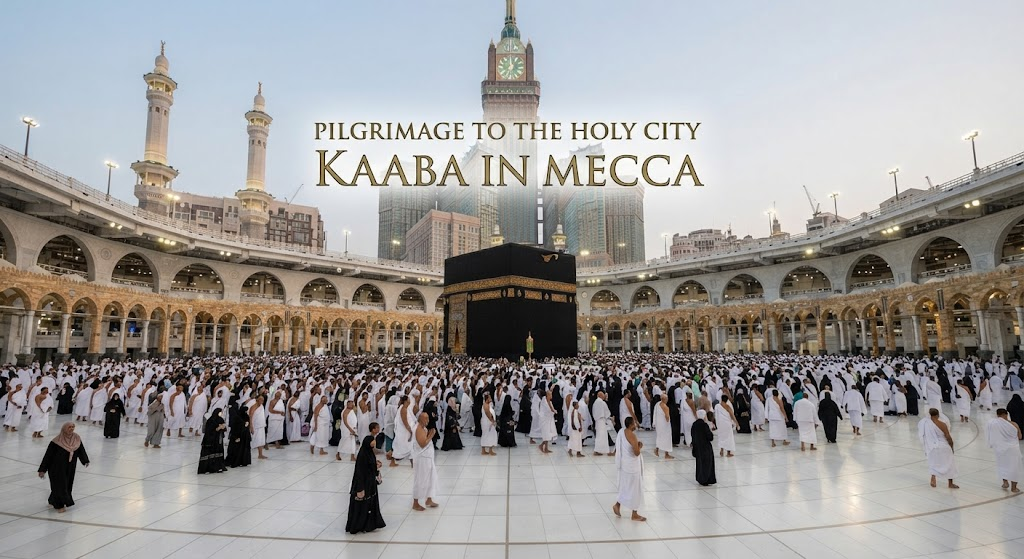
Pillar 5: Hajj (Pilgrimage to Makkah)
Meaning: Visiting the holy city of Makkah once in a lifetime if physically and financially able.
Every year, millions of Muslims from around the world gather together to worship Allah.
Real-Life Example
Imagine people from every country wearing simple white clothing and praying together as one family without caring about wealth, race, or nationality.
This shows that all Muslims are equal before Allah.
Why It Matters
- Strengthens faith.
- Promotes unity among Muslims.
- Reminds believers that everyone is equal before Allah.
Simple Diagram of the Five Pillars
                 THE 5 PILLARS OF ISLAM

                     ☪ Islam
                        │
 ┌──────────┬──────────┬──────────┬──────────┬──────────┐
 │          │          │          │          │
Shahadah   Salah      Zakah      Sawm      Hajj
(Faith)   (Prayer)   (Charity) (Fasting) (Pilgrimage)
 │          │          │          │          │
Believe   Pray      Help      Fast in    Visit
in Allah  5 Times   Others    Ramadan    Makkah
How the Five Pillars Work Together
Think of the Five Pillars as five daily habits that strengthen a Muslim’s life.
| Pillar | Teaches |
|---|---|
| Shahadah | Faith in Allah |
| Salah | Discipline and remembrance |
| Zakah | Kindness and generosity |
| Sawm | Patience and self-control |
| Hajj | Unity and obedience |
Together, these pillars help Muslims become better worshippers and better human beings.
Teaching the Five Pillars to Children
Children learn best when lessons are simple and connected to everyday life.
Parents can:
- Explain one pillar at a time.
- Share real-life examples.
- Read Islamic stories together.
- Practice Salah as a family.
- Encourage acts of kindness and charity.
- Celebrate learning with praise and encouragement.
Making learning enjoyable helps children remember these important lessons.
Final Thoughts
The Five Pillars of Islam are more than religious duties—they are a way of life. They teach Muslims to believe sincerely, pray regularly, care for others, practice self-control, and remain united as one community.
Whether you are just beginning to learn about Islam or teaching your children, understanding these five pillars is the first step toward building a strong Islamic foundation.
Remember, every great journey begins with one small step. Learning and practicing the Five Pillars brings us closer to Allah and helps us live with faith, kindness, and purpose.
Frequently Asked Questions (FAQs)
What are the Five Pillars of Islam?
The Five Pillars are Shahadah (Faith), Salah (Prayer), Zakah (Charity), Sawm (Fasting in Ramadan), and Hajj (Pilgrimage to Makkah).
Why are the Five Pillars important?
They form the foundation of Islamic worship and guide Muslims in their daily lives.
Can children learn the Five Pillars easily?
Yes. Using simple language, stories, and real-life examples makes them easy for children to understand and remember.
Which pillar comes first?
The first pillar is Shahadah, the declaration of faith that there is no god except Allah and that Prophet Muhammad (ﷺ) is His Messenger.
Primary Tags:
Five Pillars of Islam, Islam for beginners, Islamic education, learn Islam, Shahadah, Salah, Zakah, Sawm, Hajj, Islamic basics
Secondary Tags:
Five Pillars of Islam for kids, Islam explained simply, Muslim beliefs, Islamic learning, Ramadan fasting, prayer in Islam, charity in Islam, Hajj guide, Quran education, Muslim children
Long-Tail SEO Tags:
what are the Five Pillars of Islam, Five Pillars of Islam explained simply, Five Pillars with real-life examples, Islamic lessons for children, Islam basics for beginners, easy guide to the Five Pillars of Islam, teaching Islam to kids, learn Islam at home, Islamic education for families, beginner’s guide to Islam