Learning to read the Quran is one of the most rewarding journeys a Muslim can begin. Whether you are a child, an adult, or someone returning to the Quran after many years, the process starts with the same first step—learning the Arabic letters.
Many beginners worry that Quran reading is too difficult, especially if Arabic is not their native language. The truth is that Quranic literacy is built gradually. You don’t have to master everything in one day. By learning one skill at a time and practicing regularly, you can progress from recognizing individual letters to confidently reading complete Quranic verses.
In this guide, we’ll walk through the essential stages of Quranic literacy in a simple and beginner-friendly way.
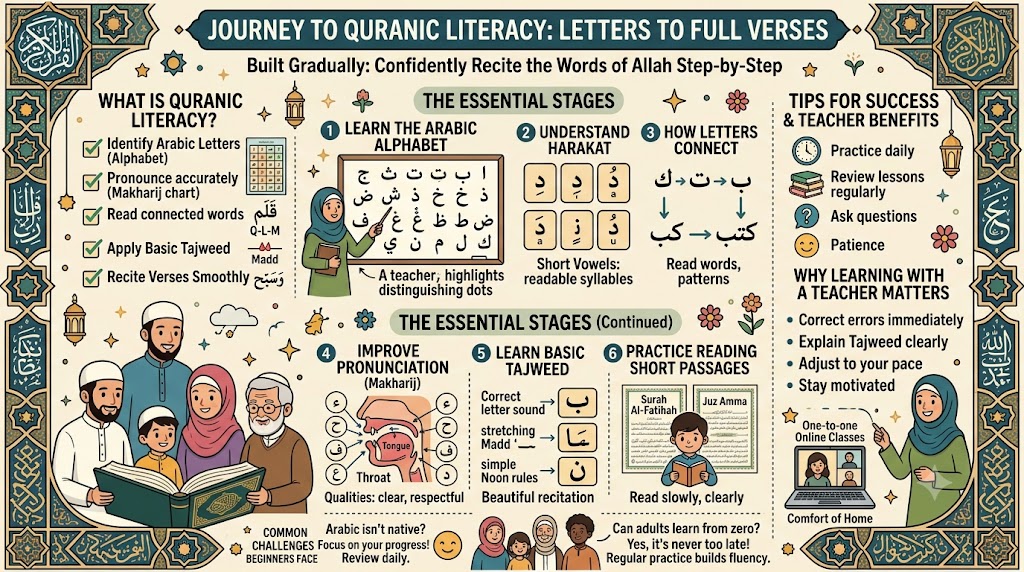
What Is Quranic Literacy?
Quranic literacy means having the ability to read the Quran accurately and confidently. It includes more than simply recognizing Arabic letters. A Quran-literate student can:
- Identify Arabic letters correctly
- Pronounce letters accurately
- Read connected words
- Apply basic Tajweed rules
- Recite Quranic verses smoothly
The goal is not only to read the Quran but to recite it correctly and respectfully.
Step 1: Learn the Arabic Alphabet
Every Quran learner begins by studying the Arabic alphabet.
Arabic has 28 letters, and each one has its own pronunciation. Some letters may look similar, but small differences in dots or pronunciation make them unique.
At this stage, focus on:
- Learning each letter’s name
- Memorizing its sound
- Recognizing its written form
- Distinguishing similar letters
Take your time. A strong foundation makes future lessons much easier.
Step 2: Understand Harakat (Short Vowel Marks)
Once you know the letters, the next step is learning Harakat, the small symbols that tell you how to pronounce each letter.
The three basic Harakat are:
- Fatha (َ) – short “a” sound
- Kasra (ِ) – short “i” sound
- Damma (ُ) – short “u” sound
These simple marks transform individual letters into readable syllables and words.
Step 3: Learn How Letters Connect
Arabic letters change their shape depending on where they appear in a word.
For beginners, this can seem confusing, but it becomes natural with practice.
You will learn to:
- Connect two letters
- Read three-letter words
- Recognize common word patterns
- Read complete Arabic words
This is often the stage where students begin feeling more confident because they can finally read actual words.
Step 4: Improve Your Pronunciation (Makharij)
Correct pronunciation is one of the most important parts of Quran learning.
Each Arabic letter comes from a specific place in the mouth or throat. These pronunciation points are called Makharij.
For example:
- Some letters are pronounced from the throat.
- Some are produced using the tongue.
- Others come from the lips.
Learning Makharij helps prevent pronunciation mistakes that could change the meaning of Quranic words.
A qualified teacher can listen to your recitation and guide you toward accurate pronunciation.
Step 5: Learn Basic Tajweed
After becoming comfortable with reading words, students begin learning Tajweed.
Tajweed is the set of rules that helps Muslims recite the Quran beautifully and correctly.
Beginners usually learn:
- Correct letter pronunciation
- Stretching sounds (Madd)
- Noon Saakin and Tanween rules
- Meem Saakin rules
- Proper stopping and starting
You do not need to memorize every rule immediately. Learn gradually while practicing your reading.
Step 6: Practice Reading Short Quranic Passages
Once you understand the basics, start reading short sections of the Quran.
Many beginners begin with:
- Surah Al-Fatihah
- Short Surahs from Juz Amma
- Daily prayer Surahs
Read slowly and clearly.
It is better to read a few verses correctly than to rush through many pages with mistakes.
Step 7: Build Confidence Through Daily Practice
Consistency is one of the biggest keys to Quranic literacy.
Even a short daily routine can produce excellent results.
For example:
- Review yesterday’s lesson.
- Learn one new concept.
- Read a few lines from the Quran.
- Practice pronunciation with your teacher.
Daily practice strengthens memory and improves fluency over time.
Common Challenges Beginners Face
“Arabic Looks Too Difficult”
Every learner feels this way at first. As you continue practicing, the letters become familiar and easier to recognize.
“I Keep Forgetting the Letters”
Revision is part of learning. Reviewing previous lessons every day helps build long-term memory.
“My Pronunciation Isn’t Good”
Pronunciation improves with practice and teacher feedback. Don’t be discouraged by early mistakes.
“I’m Learning More Slowly Than Others”
Everyone learns at a different pace. Focus on your own progress instead of comparing yourself with others.
Why Learning With a Qualified Teacher Matters
Although books and videos are helpful, they cannot always correct pronunciation mistakes.
A qualified Quran teacher can:
- Listen to your recitation
- Correct errors immediately
- Explain Tajweed clearly
- Adjust lessons to your learning level
- Keep you motivated
Personal guidance often helps students improve more quickly and confidently.
Benefits of Learning the Quran Online
Today, online Quran classes make learning easier than ever.
Students can study from the comfort of home while receiving individual attention.
Benefits include:
- One-to-one live classes
- Flexible scheduling
- Experienced Quran teachers
- Personalized lesson plans
- Comfortable home learning environment
Whether you are a child, a busy parent, or a working professional, online classes make Quran learning accessible for everyone.
Tips for Success
To make steady progress:
- Practice every day, even if only for 20 minutes.
- Review previous lessons regularly.
- Focus on accuracy before speed.
- Ask questions whenever you feel confused.
- Stay patient and trust the learning process.
Remember, every expert Quran reader once started with the first Arabic letter.
Final Thoughts
Learning to read the Quran is a journey built on patience, consistency, and sincere effort. By starting with the Arabic alphabet, learning Harakat, improving pronunciation, understanding Tajweed, and practicing regularly, you can gradually move from recognizing individual letters to reading complete Quranic verses with confidence.
No matter your age or background, it is never too late to begin. Every lesson brings you closer to understanding and reciting the words of Allah with clarity and confidence.
Start today, remain consistent, and enjoy every step of your Quran learning journey.
Frequently Asked Questions (FAQs)
Can adults learn Quran reading from scratch?
Yes. Many adults begin learning the Quran with no prior knowledge and make excellent progress through regular practice and proper guidance.
How long does it take to become fluent in Quran reading?
The timeline depends on your consistency, practice, and learning pace. Most students improve steadily with regular lessons and daily revision.
Is Tajweed necessary for beginners?
Yes. Beginners should start with basic Tajweed rules and gradually learn more advanced rules as they improve.
Can I learn the Quran online?
Absolutely. One-to-one online Quran classes provide personalized instruction, pronunciation correction, and flexible scheduling, making them ideal for beginners.