Learning to read the Quran is a special journey that begins with a strong foundation. For beginners, the Noorani Qaida is one of the most effective ways to learn Arabic letters, pronunciation, and basic Quran reading rules step by step.
Many students, especially children and new learners, find Arabic reading difficult at the beginning. However, with the right guidance, regular practice, and patience, anyone can learn Noorani Qaida and move towards confident Quran recitation.
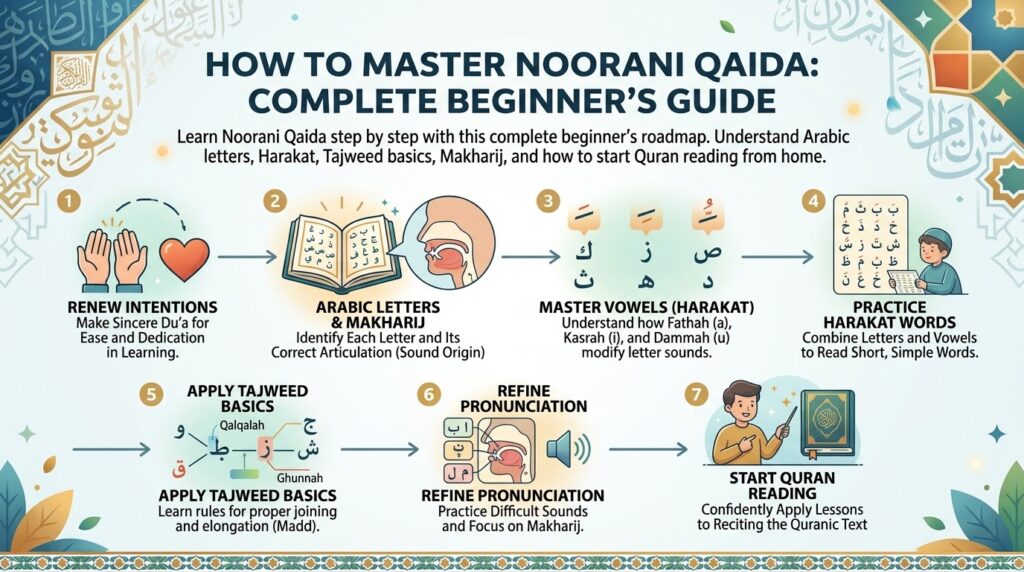
This complete beginner’s roadmap will explain how to master Noorani Qaida from the first lesson until you are ready to read the Quran.
What Is Noorani Qaida?
Noorani Qaida is a beginner-level book designed to teach the basics of Quran reading. It helps students understand Arabic letters, their sounds, joining rules, and pronunciation before they start reading the Quran.
Think of Noorani Qaida as the first step toward Quran recitation. Just like children learn the alphabet before reading a book, Quran learners learn Noorani Qaida before reading Quranic verses.
It builds the foundation needed for:
- Correct Arabic pronunciation
- Smooth Quran reading
- Understanding Tajweed rules
- Avoiding common reading mistakes
Step 1: Learn Arabic Letters Properly
The first step in mastering Noorani Qaida is learning all Arabic letters.
Students should learn:
- The shape of each letter
- The correct sound of each letter
- The difference between similar letters
For example, some Arabic letters may look or sound similar, but their pronunciation comes from different parts of the mouth.
A beginner should focus on accuracy rather than speed. Correct pronunciation from the beginning creates strong Quran reading skills.
Step 2: Understand Letter Sounds With Harakat
After learning individual letters, the next step is learning Harakat (vowel signs).
These include:
- Fatha (َ ) – produces an “a” sound
- Kasra (ِ ) – produces an “i” sound
- Damma (ُ ) – produces an “u” sound
Students learn how letters change their sounds when different Harakat are added.
This step helps beginners start reading simple Arabic combinations.
Step 3: Practice Joining Letters Together
Arabic letters change their shape when they come together in words. Noorani Qaida teaches students how letters connect and form readable words.
At this stage, students practice:
- Two-letter combinations
- Three-letter combinations
- Reading connected words
Regular practice helps students recognize Quranic words more easily.
Step 4: Learn Tanween and Other Basic Rules
Once students understand basic reading, they move towards more advanced lessons, including:
- Tanween sounds
- Noon Saakin rules
- Meem Saakin rules
- Qalqalah letters
- Madd (stretching sounds)
These lessons introduce students to the basics of Tajweed and prepare them for Quran recitation.
Step 5: Improve Makharij (Correct Pronunciation)
One of the most important parts of Noorani Qaida is learning Makharij, which means the correct places where Arabic letters are pronounced.
For example:
- Some letters come from the throat
- Some letters come from the tongue
- Some letters come from the lips
Correct Makharij helps learners pronounce Quranic words accurately and prevents mistakes that may change meanings.
Step 6: Practice Daily With a Teacher
Consistency is the key to mastering Noorani Qaida.
A good learning routine can include:
- Daily 20–30 minutes practice
- Revision of previous lessons
- Reading aloud to a teacher
- Correction of pronunciation mistakes
A qualified Quran teacher can identify mistakes immediately and guide students according to their learning level.
Step 7: Move From Noorani Qaida to Quran Reading
After completing Noorani Qaida, students are usually ready to begin reading the Quran.
They can start with:
- Short Surahs
- Juz Amma
- Complete Quran reading (Nazra)
The skills learned in Noorani Qaida make Quran reading easier and more accurate.
Common Mistakes Beginners Make While Learning Noorani Qaida
1. Learning Too Quickly
Trying to finish lessons quickly without understanding creates weak foundations.
2. Ignoring Pronunciation
Reading letters without focusing on correct sounds can create long-term mistakes.
3. Not Revising Previous Lessons
Revision helps students remember and improve their reading skills.
4. Practicing Only Occasionally
Regular small practice is more effective than long sessions once in a while.
How Long Does It Take to Complete Noorani Qaida?
The learning time depends on the student’s age, dedication, and practice routine.
Some students may complete it within a few months, while others may need more time. The goal should not only be finishing the book but learning it correctly.
Quality learning creates better Quran recitation skills.
Why Online One-to-One Noorani Qaida Classes Are Helpful
Online Quran classes allow students to learn Noorani Qaida from home with personal attention.
Benefits include:
- One-to-one learning sessions
- Flexible timings
- Individual correction
- Comfortable home environment
- Progress according to student ability
Children and adults can both benefit from personalized Quran learning with an experienced teacher.
Start Your Noorani Qaida Journey Today
Mastering Noorani Qaida is the first important step toward reading the Quran correctly. With patience, practice, and proper guidance, beginners can build a strong foundation and develop confidence in Quran recitation.
Every great Quran reader started with the first letter. Begin your journey today and take the first step toward beautiful Quran reading.