Learn Quran at Home: Learning the Quran is a beautiful journey that brings peace, guidance, and a stronger connection with Allah. Many people think that learning the Quran requires going to a mosque or having a teacher nearby, but today, with online learning, anyone can start their Quran journey from the comfort of their home.
Whether you are a complete beginner, a child learning their first Arabic letters, or an adult who wants to improve Quran recitation, following the right steps can make the process easier and more enjoyable.
In this guide, we will explain how you can learn the Quran at home step by step, starting from zero and reaching confident Quran recitation.
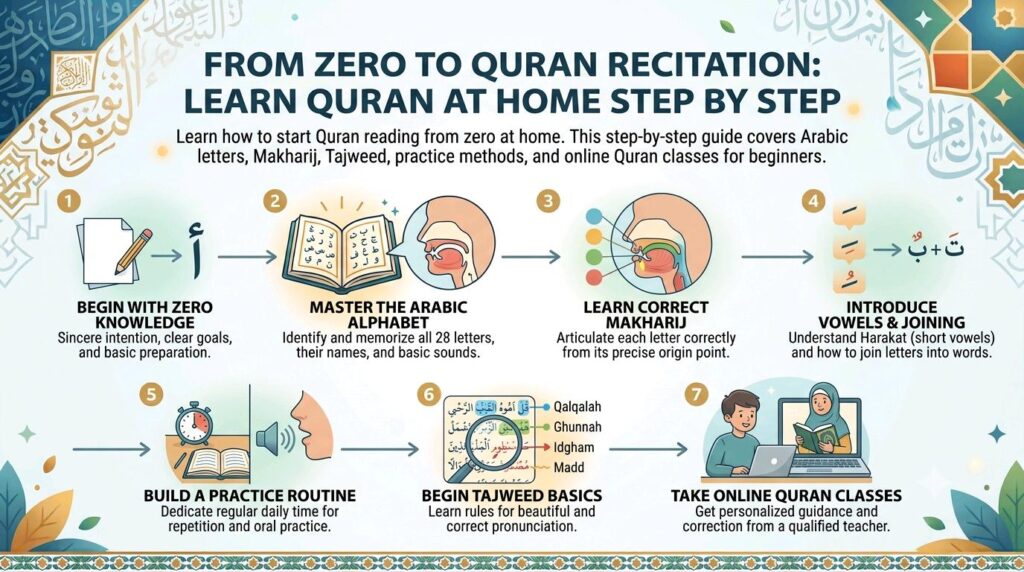
Step 1: Start With the Arabic Letters (Qaida Foundation)
Every Quran learner begins with understanding the Arabic alphabet. If you cannot recognize Arabic letters, the first step is to learn their shapes and sounds.
A beginner usually starts with:
- Arabic letters (Alif, Baa, Taa, etc.)
- Correct pronunciation of each letter
- Connecting letters together
- Basic vowel sounds (Fatha, Kasra, Damma)
Many students use beginner books like Noorani Qaida, Iqra Qaida, or Ahsan-ul-Qawaid to build a strong foundation.
A strong foundation makes Quran reading easier and helps avoid pronunciation mistakes later.
Step 2: Learn Correct Pronunciation (Makharij)
The Quran is not just about reading words; it is about reading them correctly.
Every Arabic letter has a specific place from where it comes, known as Makharij. For example, some letters come from the throat, some from the tongue, and others from the lips.
Learning Makharij helps students:
- Pronounce Quranic words correctly
- Avoid changing meanings accidentally
- Improve their recitation quality
A qualified Quran teacher can listen to your recitation and correct mistakes that you may not notice yourself.
Step 3: Understand Basic Tajweed Rules
Tajweed means reading the Quran with proper rules and pronunciation.
Beginners do not need to learn all Tajweed rules at once. They can start with simple concepts such as:
- Proper pronunciation of letters
- Rules of Noon Saakin and Tanween
- Madd (stretching sounds)
- Stopping and continuing correctly
Learning Tajweed step by step helps you recite the Quran beautifully and confidently.
Step 4: Practice Reading Short Surahs
After learning basic letters, sounds, and Tajweed, start practicing Quran verses.
Most beginners begin with:
- Surah Al-Fatihah
- Short Surahs from Juz Amma
- Daily prayers’ Surahs
Regular practice is the key. Even spending 20–30 minutes daily can create great improvement over time.
Step 5: Learn With a Qualified Quran Teacher Online
Many students struggle because they try to learn alone without guidance. A Quran teacher provides personal correction and helps students progress faster.
Online Quran classes offer benefits such as:
- One-to-one attention
- Flexible class timings
- Learning from home
- Regular progress tracking
- Personal guidance according to the student’s level
A dedicated teacher can identify your mistakes and help you improve your recitation step by step.
Step 6: Make Quran Learning a Daily Habit
Consistency is more important than studying for many hours once a week.
A simple daily routine can include:
- 5 minutes revision
- 20 minutes new learning
- 5 minutes practice
Small daily efforts create long-term results.
Parents can also encourage children by making Quran time a positive and enjoyable experience rather than a burden.
Step 7: Move Towards Fluent Quran Recitation
With regular practice, students gradually move from:
Recognizing letters → Reading words → Reading verses → Reciting complete Surahs
Everyone learns at a different pace. Some students progress quickly, while others need more time. The important thing is to continue learning with patience and dedication.
Common Mistakes Beginners Should Avoid
Many beginners make these mistakes:
1. Learning Without a Teacher
Self-learning can lead to incorrect pronunciation habits.
2. Ignoring Tajweed
Reading quickly without understanding Tajweed rules may affect accuracy.
3. Lack of Regular Practice
Long breaks make it harder to remember what you learned.
4. Feeling Discouraged
Learning the Quran is a journey. Progress comes with patience and consistency.
Can Children Learn Quran at Home?
Yes, children can learn the Quran effectively from home with proper guidance.
Online Quran classes are especially helpful for children because they provide:
- A safe learning environment
- Individual attention
- Flexible schedules
- Teachers who understand children’s learning needs
With encouragement from parents and support from a good teacher, children can develop a lifelong connection with the Quran.
Start Your Quran Journey Today
Learning the Quran from zero may seem challenging at first, but with the right method, regular practice, and a supportive teacher, anyone can learn to recite the Quran correctly.
Your Quran journey starts with a single letter, a single verse, and a commitment to keep learning.
Begin today and take the first step toward beautiful Quran recitation from the comfort of your home.