Teaching your child the Quran is one of the most valuable investments you can make in their future. However, keeping children motivated throughout their Quran learning journey can sometimes be challenging. Young learners naturally have short attention spans, and if lessons become repetitive or stressful, they may lose interest.
The good news is that Quran learning doesn’t have to feel like a chore. With the right approach, you can create a positive, enjoyable environment where your child looks forward to every lesson.
In this guide, we’ll explore seven practical and engaging ways to keep your child motivated while learning the Quran at home or through online Quran classes.
Why Motivation Matters in Quran Learning
Motivation plays a major role in helping children develop a lifelong connection with the Quran.
When children enjoy learning, they are more likely to:
- Attend lessons regularly
- Practice without being reminded
- Build confidence
- Remember what they learn
- Develop a love for the Quran
The goal is not only to teach children how to read the Quran but also to help them enjoy the journey.
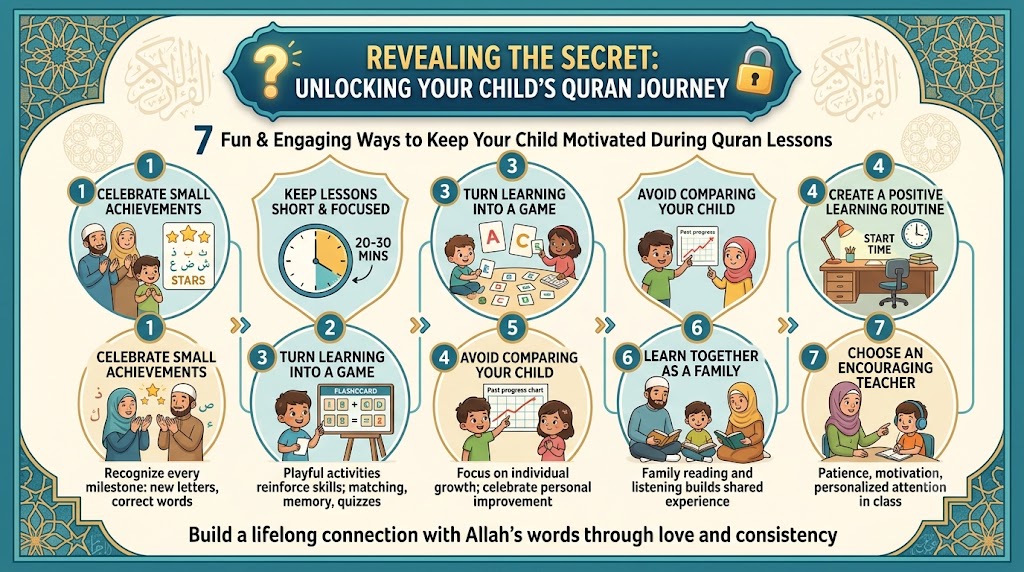
1. Celebrate Small Achievements
Children feel encouraged when their efforts are recognized.
Instead of waiting until they complete an entire Qaida or Surah, celebrate smaller milestones, such as:
- Learning five new Arabic letters
- Reading a page without help
- Improving pronunciation
- Memorizing a short Surah
Simple words like “I’m proud of you” or “You worked really hard today” can boost a child’s confidence.
Positive encouragement often motivates children more than material rewards.
2. Keep Lessons Short and Focused
Long lessons can make children feel tired and distracted.
For most young learners, 20 to 30 minutes is enough to stay focused and make meaningful progress.
A balanced lesson might include:
- 5 minutes of revision
- 15 minutes of new learning
- 5–10 minutes of reading practice
Short lessons help children stay engaged and reduce frustration.
3. Turn Learning Into a Game
Children naturally enjoy games, so why not include them in Quran lessons?
Try activities like:
- Arabic letter matching games
- Flashcards
- Pronunciation challenges
- Memory games
- Quiz competitions
Learning through play makes lessons exciting while reinforcing important skills.
4. Create a Positive Learning Routine
Children thrive on routines.
Choose a regular time each day for Quran lessons so they become part of your child’s daily schedule.
To make the routine enjoyable:
- Choose a quiet learning space.
- Remove distractions like television and mobile devices.
- Begin each lesson with a smile and encouraging words.
- End the lesson by praising your child’s effort.
A calm and predictable routine helps children feel comfortable and prepared to learn.
5. Avoid Comparing Your Child With Others
Every child learns at a different pace.
Comparisons can lower confidence and make children anxious.
Instead of comparing siblings or classmates, compare your child’s progress with their own previous achievements.
For example:
Instead of saying:
“Your friend finished faster than you.”
Say:
“Look how much you’ve improved since last month.”
This helps children focus on personal growth rather than competition.
6. Learn Together as a Family
Children are inspired by what they see at home.
When parents read the Quran regularly, children often become more interested in doing the same.
You can:
- Read together after Salah.
- Revise Surahs as a family.
- Listen to Quran recitation together.
- Encourage siblings to support one another.
Family involvement turns Quran learning into a shared experience instead of an individual task.
7. Choose a Patient and Encouraging Quran Teacher
A supportive teacher can make a huge difference in a child’s motivation.
Children learn best when they feel comfortable asking questions and making mistakes.
An experienced Quran teacher should:
- Encourage rather than criticize
- Teach according to the child’s ability
- Correct mistakes gently
- Keep lessons interactive
- Celebrate progress
One-to-one online Quran classes are especially helpful because teachers can adapt lessons to each child’s learning style and pace.
Common Mistakes That Reduce Motivation
Avoid these habits that can discourage children:
Expecting Perfection
Children are still learning. Mistakes are a natural part of the process.
Focusing Only on Mistakes
Correct errors gently, but also recognize what your child did well.
Skipping Revision
Regular revision builds confidence and strengthens memory.
Making Lessons Feel Like Punishment
Quran learning should be associated with encouragement, patience, and positivity—not fear or pressure.
How Parents Can Support Quran Learning Every Day
Parents don’t need to be Quran teachers to make a positive impact.
Simple ways to support your child include:
- Asking what they learned today
- Listening while they practice
- Praising effort instead of only results
- Creating a quiet place for lessons
- Encouraging daily revision
Even a few minutes of involvement each day can make a lasting difference.
Benefits of One-to-One Online Quran Classes
Many families choose online Quran classes because they provide personalized attention and flexible scheduling.
Benefits include:
- Individual learning plans
- Live interaction with qualified teachers
- Correct pronunciation guidance
- Flexible class timings
- Comfortable learning from home
- Lessons designed for each child’s pace
Personalized instruction often helps children stay engaged and confident throughout their learning journey.
Final Thoughts
Keeping your child motivated during Quran lessons doesn’t require expensive tools or complicated teaching methods. What matters most is creating a positive, supportive environment where learning feels rewarding.
Celebrate small successes, keep lessons enjoyable, practice consistently, and encourage your child with kindness. Over time, these simple habits can help build not only strong Quran reading skills but also a lifelong love for the Quran.
Remember, the goal is not just to finish lessons—it is to inspire your child to cherish the Quran for years to come.
Frequently Asked Questions (FAQs)
How can I make Quran lessons more enjoyable for my child?
Use games, praise progress, keep lessons short, and create a positive learning routine. Children are more motivated when learning feels fun and encouraging.
What is the ideal length of a Quran lesson for children?
Most children learn best with lessons lasting 20 to 30 minutes, depending on their age and attention span.
How do I motivate a child who doesn’t want to study the Quran?
Avoid pressure, celebrate small achievements, involve the family, and choose a patient teacher who makes lessons interactive and enjoyable.
Are online Quran classes suitable for children?
Yes. One-to-one online Quran classes provide personalized attention, flexible scheduling, and a comfortable learning environment that helps many children stay motivated.